getting on your nerves? episode 2: the upper body edit
In episode 2 of getting on your nerves?, Dr Anna Persaud is joined by Dr Lana Gault and This Works ambassador Mithra Nandu to explore how stress and nervous system dysregulation show up in the upper body. From jaw tension, posture, breathing and tech neck to hair, skin, vagus nerve stimulation and affective touch, they discuss how the body can hold stress – and the everyday tools that can help move us from fight or flight towards rest and digest.

part 1: how stress shows up in the upper body
Anna: My name is Dr Anna Persaud. I’m the CEO of This Works.
Welcome to getting on your nerves?, a podcast where we explore the science behind stress, sleep and nervous system regulation.
Each episode unpacks why so many of us feel permanently overstimulated and unable to properly switch off through conversations around stress, recovery, wellbeing and the connection between the brain and the body.
Since 2004, This Works has pioneered sleep science through clinical trials and neuroscience research designed to help move the body from fight or flight into rest and digest, supporting better sleep, recovery and nervous system balance.
Today I’m in discussion with Dr Lana Gault, who is a medical doctor, but she is also an aesthetic medicine expert.
Hi, Lana.
Lana: Hi.
Anna: How are you? Welcome back to the podcast.
Lana: Thank you.
Anna: Today we’re going to talk about the upper body.
This is really to help us understand how stress and nervous system dysregulation can affect our upper body in particular, and what that means in terms of how we look as well as how we feel.
Often stress is felt in the mind and the body before it shows itself in the face.
But it’s true, Lana, isn’t it, that there is something called the stress face?
Lana: Yes.
Anna: Talk to me about the medical side of stress in the body if we go from the top to the middle.
What are some of the things nervous system dysregulation causes in terms of our musculature, our autonomic nervous system and the lymphatic system?
There are many systems affected, so talk us through some of those.
Lana: When we’re stressed, we tend to have really tight muscles.
Our posture can change.
The way we look can look quite different.
There are multiple signs on the body.
If we start from the top, when we’re in a stressful period in our lives, we may have a more hunched-over appearance.
Our head becomes heavier.
We may look angrier.
We get that frowning between our eyebrows.
We’re always ready, on edge and hypervigilant when we’re stressed.
Anna: Stress is something none of us enjoys, although it is part of life.
When we’re dealing with stressors that cause discomfort, the fight-or-flight system is dominant.
It’s there to protect us.
It’s there to make us ready for action.
We need it.
That’s how we survive.
But what we want is to be able to manage that so that when we are not facing a stressor, we’re able to reverse it and move into the parasympathetic, the rest-and-digest system.
That’s what we all want.
We want agility.
We want to be able to move between those states as the environment demands.
What we don’t want is that sense of stress to affect not only our mind, but also how we look.
People might say, “You’re looking stressed.”
In the short term, that might mean you look fatigued.
You might have a frown because the muscles around the eyes tighten to give you more focus.
But what happens over time?
Am I right that changes can happen long term?
Lana: Yes.
When we’re stressed, going back to what I was saying about muscle contraction, we may get lines appearing more strongly on the face because those muscles are contracting more.
As a result, we can look like we’re frowning a lot more than usual.
If we look at the neck, for example, if our shoulders are hunched up and we’re bent over, over time we have that constant contraction of the muscles in our shoulders.
We’ll get tension in the back of the head, which can cause headaches that go back up into the neck.
We may get shoulder pain.
As a result, we can also look more nervous.
We might not seem as confident because we’re not sitting back nice and straight and keeping our head held high.
When we’re stressed, our head may bend forward.
Our head is actually quite heavy – around 4.5 to 5.5 kilograms on average.
Even a tiny change in how we hold our head can put strain on the back of the neck.
It can cause contraction of those muscles as well as other muscles becoming weaker because they’re not being used as much.
muscle tension, posture and the stress response
Anna: I think many people will be familiar with that sense of muscle tension up here.
Feeling that the shoulders and upper back are tense.
When we’re in a state of chronic stress, those muscles don’t fully relax.
That’s why it’s so important that we move and stretch those muscles out.
We want to interrupt that relationship between the body and the mind.
When the muscles are tense, it can reaffirm to the brain that there is a reason to be on alert.
We need to break that by stretching the muscles out.
In the face itself, I’ve been a teeth grinder in the past.
I think you’ve been a teeth grinder too.
Lana: Yes, exactly.
Anna: What happens around the jaw?
Because I think there can be quite serious implications.
jaw clenching and teeth grinding
Lana: Personally, I had some dental problems as a result of it because I was grinding my teeth so much that I was wearing down the enamel.
The reason this happens is because we have muscles of chewing in the cheeks.
They’re used for chewing and grinding when we’re eating food.
However, if we use them too much, for example when we’re stressed, we tend to clench our jaw.
As a result, there is constant contraction of those muscles.
For me, it was happening subconsciously, particularly at night.
Those muscles were getting stronger and stronger.
You can get headaches from that because it causes tension within that area of the face.
But it doesn’t only cause headaches.
It can also change how your face appears.
Your cheeks can become wider.
Your jaw can become wider and more square as those muscles get stronger.
It’s a bit like going to the gym.
If you want to make your biceps stronger, you continually contract that muscle and over time you hope to get a bigger bicep.
But in the face, that can be counterproductive.
You end up getting a really tense jaw and feeling tense all the time because you can feel those muscles are really strong.
Anna: That’s something I don’t think people always realise.
Chronic stress can show itself in the lower jaw.
You feel it too, as you said, in headaches and neck aches.
I actually had a persistent earache for the same reason.
Eventually, it was diagnosed as tension in my jaw.
Learning how to relax the jaw is a key anti-stress response.
It’s something really important for people to learn.
stress, posture and breathing
Anna: As we come down the body, we’ve talked about the face and the look of stress on the face.
You’ve talked about the shoulders.
But I also believe stress has a very significant impact on our breathing.
Lana: Exactly.
Anna: Breathing and the nervous system are intrinsically linked.
Tell us more about that.
Lana: When we are in fight-or-flight mode, we’re in that sympathetic state.
The parasympathetic nervous system is the rest-and-digest side.
We want to support that parasympathetic response because that’s when our breathing is nice and calm and we’re able to regulate ourselves.
In the fight-or-flight state, we tend to have really shallow breathing.
We aren’t able to expand our lungs fully and we aren’t bringing air as deeply into the lungs as we ideally would.
When we’re stressed, we can be bent over and ready for a fight.
That reduces the capacity of our lungs to expand because there’s less space.
The diaphragm can’t flatten as much as it should when we take that big breath in.
As a result, we have shallow breathing.
We’re not breathing as deeply as we ideally could.
Breathing in oxygen and breathing out carbon dioxide are both important physiological processes.
Being able to stimulate the parasympathetic nervous system and relax the upper body helps us open the shoulders, expand the lungs and allow the diaphragm to move more effectively.
Anna: When we choose to use breath techniques, such as exhaling for longer than the inhale, or doing a physiological sigh with a big exhale, that can help bring the parasympathetic system into action.
It can help to override feelings of stress and anxiety.
It’s a very quick tool that we can all use when we feel overly activated to bring balance back.
I think breathwork is very powerful.
Lana: Absolutely.
part 2: tech neck, screens, hair and the changing face of stress
how laptop and phone use affect the upper body
Anna: Stress is one thing, but the way we choose to work also has another impact.
Sometimes we can’t do anything about the stressors around us.
But we sit in chairs every day.
We use laptops.
We use phones.
Talk about how our lifestyle is affecting our upper bodies.
Lana: We can have this phenomenon called tech neck.
If someone is a laptop user for multiple hours a day, you tend to see a more hunched-over appearance.
Your head comes forward and your posture becomes worse.
As a result, we get tension in the back of the head, which we spoke about earlier.
It also means that the muscles we do want to engage, for example in our back to pull our shoulder blades backwards, become weaker because they’re not being contracted as much.
We end up with an imbalance between contraction and relaxation, but not in the way we want.
We get constant and chronic contraction.
The body becomes used to this tense feeling.
If you’re leaning over your laptop, that position brings the body back towards the posture we might adopt if we were preparing for a fight.
Think about boxers.
They’re in that hunched-over position.
They’re protecting their vital organs.
They’re protecting their head.
Their head is down.
Physiologically, that makes sense if you’re trying to protect yourself.
But when we’re working long hours on a laptop, that’s not what we need.
We don’t need to protect ourselves.
Anna: So opening up the shoulders and allowing the chest to come forward, even though that might make us feel a little vulnerable, is actually really important.
It helps strengthen the muscles in the back and gives us that postural balance.
That then signals to the brain that there isn’t a threat.
screens, eye focus and hypervigilance
Anna: As we think about the posture up here, it’s also important to talk about the eyes.
When you bring screens closer, you are forcing the eyes to focus.
When you ask the eyes to focus, you’re telling the brain, “Be alert.”
Lana: Exactly.
Anna: I don’t think we’re always mindful of that.
The closer the screen is, and the more we demand our eyes to concentrate, the more activated we can become.
Lana: Exactly.
We become more hypervigilant.
Again, it brings us back to that idea of running away from the tiger.
We need to narrow our focus.
We need to concentrate.
That can also affect how the face looks.
When you’re trying to focus on a screen, you tend to frown.
Over time that can contribute to the appearance of wrinkles, particularly between the eyebrows and on the forehead, because you’re constantly frowning at the screen.
Many people have glasses and things that can help reduce that.
But we need to be aware of it.
Even when you’re looking at a screen, you can stop and think:
“Am I frowning here?”
“How do I feel?”
“How are my shoulders positioned?”
“Where is my head?”
“How am I focusing?”
All of those things can contribute long term to problems related to laptop life.
remembering to breathe while working
Anna: I think I’m right in saying – please correct me if I’m not – that when people are using a screen up close and concentrating, they can also stop breathing properly.
They hold their breath.
That then causes more activation.
So when we’re doing screen work, we need to remember to breathe.
Use big exhales to help flush the carbon dioxide out and give that regulatory balance within the nervous system.
Lana: Yes.
I’m just as much a culprit of that as anyone.
I can feel myself holding my breath and not breathing properly.
But it’s about reducing the amount of time that happens.
Maybe a few months ago, that was happening for ten minutes.
You were holding your breath and breathing irregularly.
But now perhaps it only happens for two minutes because you’ve put in these breathwork techniques or grounding techniques.
They bring you back to where you should be.
They reduce the consequences of holding your breath and not breathing efficiently.
It’s important to be aware of it when it happens.
how chronic stress can affect the hair
Anna: Next subject is hair.
Lots of our community are very interested in hair health, hair shedding and hair colour.
I believe there is a link between chronic stress and the hair.
Let’s talk about colour to begin with.
Lana: Hair colour comes from cells called melanocytes.
As we age, and potentially under certain stress conditions, those melanocytes may not function in the same way.
The number or activity of those cells can reduce, and we can lose pigment, which contributes to grey hair.
Anna: So it happens naturally with age, but it can happen more rapidly if we’re in a state of chronic stress.
Am I right?
Lana: Stress can also affect the hair-growth cycle.
Hair follicles move through different phases.
A significant stressor can push more hairs into a resting phase.
That can mean that several months later, you notice more shedding.
Anna: We’ve got hormonal stressors too.
There’s nothing we can necessarily do about those unless we go down a medical route, and that is an option for men and women.
But stress can exacerbate the issue.
True?
Lana: Yes.
What we might see is a delay in the result.
You may have the stressor at one point in your life and not notice the hair loss until several months later.
That makes it really difficult to establish what the cause was.
Was it a new shampoo?
Was it something that happened in the past couple of weeks?
But actually, if you look back retrospectively, the stressor may have been months ago and you’re only seeing the result now.
Anna: I think that’s fascinating.
That happened to me in the summer.
I had a stressful event and the hair was shedding in the autumn.
It was shedding long after the event.
So that’s something for us all to be aware of.
aesthetic medicine and ageing well
Anna: Your practice in aesthetic medicine is really interesting.
We’re talking about nervous system care, but we are also a brand that sits between sleep, stress, nervous system regulation, skin, hair and body care.
We’re very much talking about the way skin looks.
You work in that area as well.
Explain to our community what aesthetic medicine actually is.
Originally we used to talk about Botox.
That was probably the original aesthetic medicine product that people would go and ask for, and it’s been around for a long time.
How has that evolved?
Lana: A lot of people know Botox.
Botox is actually a brand name for one form of botulinum toxin, which can be used to reduce muscle contraction.
It can be used clinically.
For example, somebody with cerebral palsy may have a contracted muscle.
Someone may have a contracted hand that reduces their ability to use that hand.
Injecting botulinum toxin into the muscles can cause them to relax.
It does this by reducing the ability of the chemical signals to make that muscle contract.
When we want a muscle to contract, the brain sends a signal.
Botulinum toxin blocks part of that signal and causes the muscle to relax.
We can use it in aesthetics, for example on the forehead, where there may be lines associated with ageing and repetitive muscle movement.
Using anti-wrinkle injections reduces the contraction of those muscles.
For example, between the eyebrows, you may get frowning and lines.
If we inject in that area, it can reduce the appearance of those lines – what people in the industry sometimes call the “11 lines” – and create a smoother effect.
Something like anti-wrinkle injections doesn’t always make lines completely disappear.
It tends to work best on dynamic wrinkles, which are lines caused by movement.
Botox may be the household name of aesthetics, but there are many other treatments.
There are injectables, microneedling and other options.
There is also a role for holistic and preventative approaches alongside aesthetic medicine.
That could mean skincare.
It could mean things such as red light therapy.
There’s a need for many different approaches.
It isn’t one-size-fits-all.
It’s personalised.
It’s about looking at how we can support ageing well using different aspects of wellness and health.
the middle ground between aesthetics and holistic care
Anna: I think this is an interesting conversation because there are camps that favour invasive treatments and camps that say, “I’m not doing that. I don’t want that. I don’t believe in that.”
But I think a middle ground is beginning to evolve.
I see it among the community and the people I know.
Menopausal women in particular may or may not be using HRT, but they want their health span to be as long as possible.
They want to live a long life, but they want their health to be good for the duration of that life.
We hear a lot about biohacking.
There’s a lot of investment going into ingestibles and injectables for prolonging health span.
Then they look at their skin.
Not just the skin on their face but also the skin on their body.
They think, “I want the skin on my body and face to look good as I age.”
I don’t expect to look like a 30-year-old because I’m not.
But I want to stay looking as good as I can for as long as I can.
Now the science is available and more accessible.
People are much more interested in aesthetic medicine and more inclined to blend it together with holistic wellness and health protocols.
That includes exercise.
Good nutrition.
Cutting down on alcohol.
Staying out of the sun.
Potentially hormone replacement therapy.
Maybe lasers.
Maybe red light.
So I would like to know more about your area because I don’t think everybody understands what skin boosters are.
What is a skin booster?
skin boosters, polynucleotides and collagen
Lana: We can use skin boosters or something called polynucleotides.
They’re quite similar in terms of the overall goal of improving skin quality, although they work differently.
Polynucleotides have become quite a big topic within aesthetics.
They’re derived from purified fragments of DNA, commonly sourced from salmon or trout.
They’re injected into the skin and can stimulate fibroblast activity.
Fibroblasts are important for collagen production.
As we age, from around our mid-twenties, collagen production gradually declines.
That’s why it becomes important to think about how we can support collagen.
Collagen is like the scaffolding or structure of your skin.
As we age, that collagen breaks down.
The structure isn’t as strong and we can get more sagging and wrinkles.
Anna: We lose definition in our jaw.
The skin starts to hang.
Lana: Exactly.
A lot of people want to use treatments that stimulate their own skin cells and support collagen production so that they can maintain stronger skin structure.
We can look at things like microneedling as well.
When you have a course of microneedling, the aim is to stimulate a controlled wound-healing response and encourage collagen production.
Anna: Wow.
Lana: That is using your body’s own response to stimulate collagen.
But we can only do that effectively if we’re looking at other things alongside it.
You mentioned exercise.
As we get older, particularly in menopausal women, body composition changes.
Muscle mass can decrease.
So strength training becomes really important.
Taking adequate protein gives the body the amino acids it needs as building blocks.
We can combine a healthy eating strategy, adequate protein, maintaining a healthy weight and exercise.
That doesn’t only help with the structure of the face and body.
Stronger muscles can increase stability and help reduce the risk of falls as we get older.
There is such a wide range of things we can do.
It’s important to look at every aspect of your life and see how you can optimise it.
We’re never going to be perfect.
But whatever you can do to optimise your health and age better for longer is better than nothing.
the foundations of healthy ageing
Anna: I think that’s a powerful message.
Thank you for bringing us back to the things within our daily lives that we can do to help our own health and wellbeing, and also how we look.
One of the foundations of stress management is sleep.
This Works is a brand that has been pioneering sleep and the importance of sleep for beauty for many years, with scientifically backed sleep research.
But it is also about your skin.
We talk about these pillars of health.
Sleep is certainly one of them.
Then there is stress management.
We’ve had so many examples today of how we need to manage stress in order to support our skin, how we look, our hair, our musculature and how the body looks and feels.
We also need to look at nutrition.
You made a great point about protein as a building block.
But we need fats too.
Lana: Exactly.
Anna: We need carbohydrates.
We need fibre.
We need a balanced diet and hydration.
All of that is important for skin health.
Then there is nervous system management.
The nervous system has an inflammatory effect.
There are physiological impacts of chronic stress that can affect the body over time.
Then we bring movement in.
And then we look at your world of medicine, which has treatments designed to support skin health for longer.
It’s not only about how I look.
It’s also about how the skin behaves.
Lana: Yes.
Even in aesthetics, it’s also about how you feel.
If I give somebody a course of anti-wrinkle injections, and they’re also using SPF and eating healthily, perhaps the treatment gives them a little bit more confidence.
Now, it would be a red flag to me if someone came in extremely self-conscious, hadn’t tried anything else and had other things going on in their life.
I need to step back and ask, “Is this really what you want?”
But treatments can have a beneficial effect.
If you feel more confident because your skin health is really good and your makeup goes on better, that can affect other areas of your life.
We all know that if we’ve had hormonal acne or changes to the skin and really bad spots for a couple of weeks, it can really get you down.
Anna: Yes.
Lana: You might not want to go out.
You might not want to meet people.
At the more extreme end, it can really affect your confidence.
You may not want to sit in front of somebody for half an hour or an hour when you’re very self-conscious about your skin.
So keeping the skin healthy is important.
Stress can impair the skin barrier and contribute to changes in sebum production, which can contribute to acne.
Going back to stress and sleep, poor sleep can also affect skin function.
It all contributes to how your skin looks and your overall skin quality.
part 3: red light, the vagus nerve and ways to regulate the nervous system
why red light is interesting for skin and recovery
Anna: We’ve talked about other ways we can treat the skin using laser, microneedling, and you mentioned red light.
It’s also referred to as photobiomodulation.
This Works has its own red light, which I’m sitting on here.
Lana: Very exciting.
Anna: Why do you like red light?
As an aesthetic medical doctor, why do you like it?
Lana: I think it’s really important to look at things that we can use to help us age better for longer.
It’s important to look at clinical data.
It shouldn’t just be a fad or something we see on TikTok.
We need to look at the science behind it.
What is really interesting about red light is that there has been research into it for many years, including work relating to wound healing.
Red light is not just about making the skin on your face look good.
It has been studied in areas including wound healing and recovery.
What I like about it is that there is scientific research behind photobiomodulation.
It isn’t simply a trend.
There’s research looking at its potential benefits for skin appearance and other aspects of recovery.
what is the vagus nerve?
Anna: As we think about autonomic balance between fight or flight and rest and digest, there has been a lot of discussion in the last few years about polyvagal theory and the vagus nerve.
Stephen Porges was the originator of polyvagal theory.
Explain a little bit about this nerve.
Lana: When we talk about the fight-or-flight response, social interaction and rest and digest, something that can contribute to that rest-and-digest response is the vagus nerve.
The vagus nerve gets its name from the idea of wandering.
It’s a very long nerve in the body and it innervates multiple areas.
It is involved with structures around the neck and voice box, and with organs including the heart and stomach.
It has multiple functions.
We can influence vagal activity in ways that can support relaxation.
It is involved in regulating processes such as heart rate, breathing and digestion.
There are many ways that we can stimulate or engage those pathways.
One way you have a particular interest in is breathwork.
Anna: Mm.
Lana: Box breathing and extending the breath out can contribute to a parasympathetic response.
stimulating the vagus nerve
Anna: I’ve done quite a lot of research myself on the vagus nerve.
We can talk about different vagal pathways in much more detail, but that’s probably too much detail for this podcast.
I use a vagus nerve stimulation device in my ear.
I use an electrical current with the intention of supporting vagal tone and giving me greater control over this parasympathetic response.
Over time, the proxy I use to look at parasympathetic functioning is heart rate variability, which I measure overnight.
I would say that since I’ve been using this system, my HRV has been trending upwards.
Using breathwork is great.
I think singing is another way.
Am I right?
Lana: Yes.
Humming as well.
Anna: Humming.
The bee.
Lana: Yes.
Humming can engage some of the same pathways.
There’s the vibration in the throat.
Singing can also help.
There’s also the example of people singing in a choir.
You get the social aspect, but you’re also getting vibration through the vocal cords.
All of that can contribute to feeling more relaxed and settled.
affective touch and the nervous system
Anna: Also touch.
There’s a type of slow touch called affective touch.
It has a very slow cadence, particularly across hairy or hirsute areas of the skin.
That can also contribute to parasympathetic regulation.
What I think is fascinating is that humans have all these ways of managing the nervous system that they don’t necessarily realise are everyday things they can do.
We evolved to survive.
The fact that many of us have become stuck in vigilance or hypervigilance is partly because our lifestyles and our use of technology can keep that part of the nervous system constantly activated.
But the flip side is all these other techniques we’ve been discussing.
Breathing techniques.
Using the eyes and looking into the distance.
Using touch.
Singing.
Humming.
Sound.
Human contact.
These are all ways humans can help regulate between these systems.
In my view, we haven’t done enough to support the parasympathetic side.
But these tools are available to us.
Lana: Exactly.
Going back to the choir example, I read about research looking at singers breathing together and changes in heart-rate patterns during group singing.
It shows that there are more ways to regulate than we sometimes think.
We need to think outside the box and ask what is actually going to stick for us.
Is it joining a choir?
Is it humming in the shower?
Is it speaking to a friend?
Anything that gives you a break and takes you out of that fight-or-flight feeling.
Anna: Thank you so much for bringing all of your knowledge and insight into aesthetic medicine and how it sits alongside other holistic ways to manage our nervous system and wellbeing.
It’s been an absolute pleasure to see you today.
Lana: I’ve loved it again.
Thank you.
part 4: beauty, ageing well and an upper body routine with Mithra
Anna: I’m talking to my friend and colleague of over 30 years, Mithra Nandu.
Hello, Mithra.
Mithra: Hello, Anna.
Anna: Welcome, Mithra.
Mithra: Thank you for inviting me.
Anna: It’s an absolute pleasure.
Today we are talking about the upper body edit.
The focus has been on how stress can affect our upper bodies.
We’re talking about musculature.
We’re talking about nervous system regulation.
And we’re talking about beauty.
When I think about beauty, I think, who do I know who has aged the most timelessly?
You are actually 58 today, right?
Mithra: Yes, it’s my birthday.
Anna: You are 58 today, which is an amazing feat for someone who looks as fantastic as you do.
Mithra: Thank you.
Anna: You have been an ambassador and model for This Works for over five years.
You look amazing and your skin is amazing.
I’m really happy you’re here today.
As we talk about the upper body, ageing and looking good and feeling great, I’d like to know more about what you do.
What’s the secret to having the upper body you have today?
Mithra’s approach to ageing well
Mithra: I have worked in the beauty industry since I was 19.
I literally left school and went straight into the beauty industry.
So I have always looked after my skin.
Other things I’ve done over the years: I’ve never smoked and I’ve stayed out of the sun.
I’ve always used products that work and deliver.
I’m a huge fan of perfect cleavage & neck serum.
I’ve been using it for 14 years.
I couldn’t go without it.
And just generally looking after myself.
I think the more you look after your body, the more you look after your mind.
I’m naturally a very anxious, stressy, hypervigilant person, so I try to bring routines in to calm myself as much as possible.
I also swim, which I love.
Not really for my body, more for my mind.
When I’m swimming, I’m really in the moment and I’m not overthinking.
I start my day like that.
I’m a big believer that how you start your morning can really dictate how your day goes.
Anna: You’ve touched on some really interesting points.
I’ve been in the beauty industry alongside you for those 30 years.
We haven’t worked together for all of them.
But we are part of a generation of post-menopausal women who have been making the best of what the cosmetics industry has to offer.
When you look at the formulations and active ingredients that have been on the market, you and I have been at the forefront of using these ingredients.
What types of ingredients do you love and think work?
Mithra: Fragrance in a product is really important to me.
It has to make me feel good when I’m using it.
I know lots of people love fragrance-free, but I don’t.
If I pick up a fragrance-free product, I’m thinking, “Where’s the smell?”
We know fragrance can affect how we feel because of its relationship with the brain.
The actives are really important because long term I want to see results.
That’s really important to me too.
And products need to be practical and easy to use because I don’t have a huge amount of time for a beauty routine.
Some nights you want to pamper yourself and you have the time.
But I also like things that multitask, that are quick, portable and that you can use on the go.
Mithra’s three essentials
Anna: If I said to you, Mithra, you could only take three products on a trip, what would they be?
Mithra: Definitely perfect cleavage & neck serum.
I could not be without it.
Anna: You could also use it everywhere on your body.
Mithra: Absolutely.
I’ve started using it on my arms as well.
Anna: The bingo wings.
Not that you’ve got them!
Mithra: I’m not sure that’s the technical term, but yes.
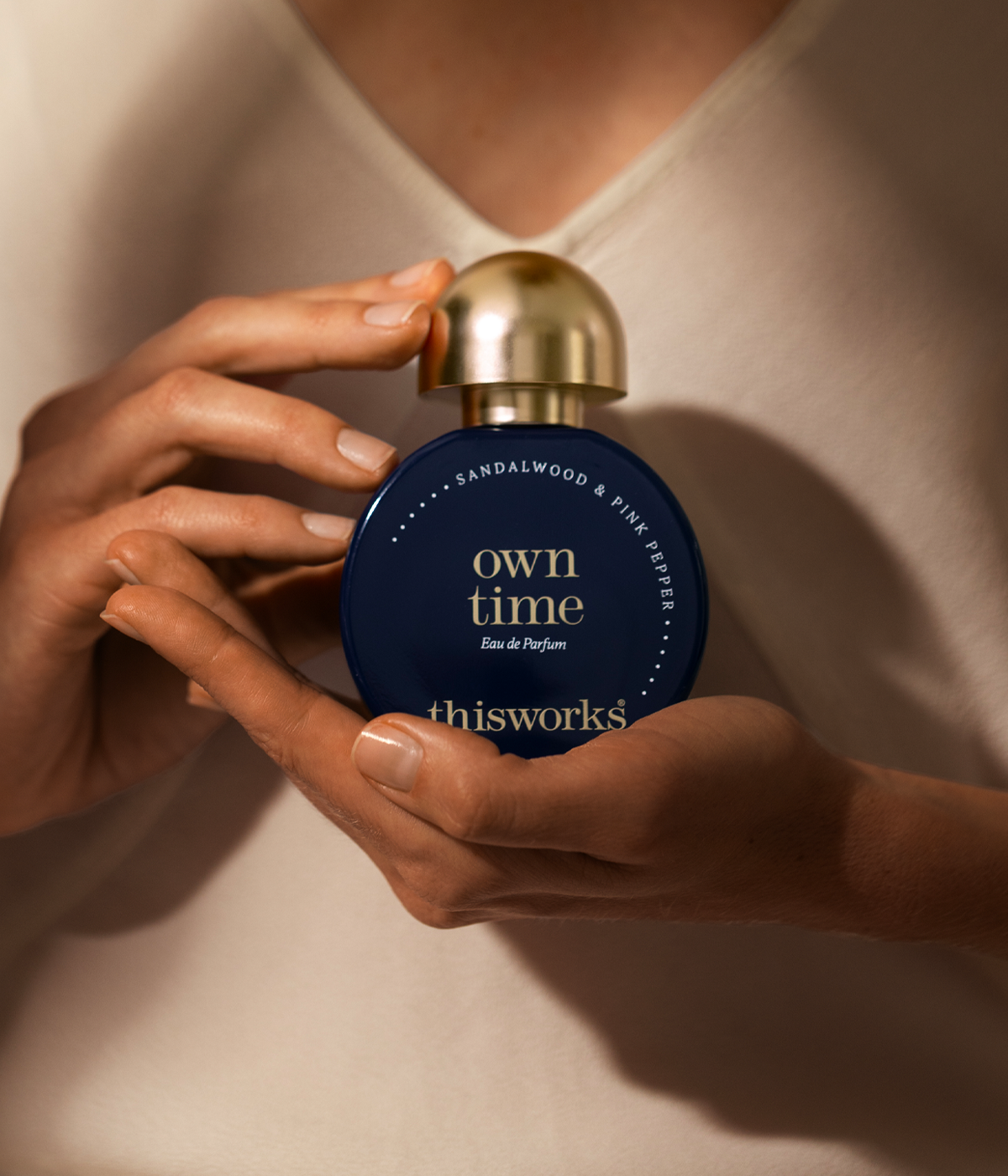
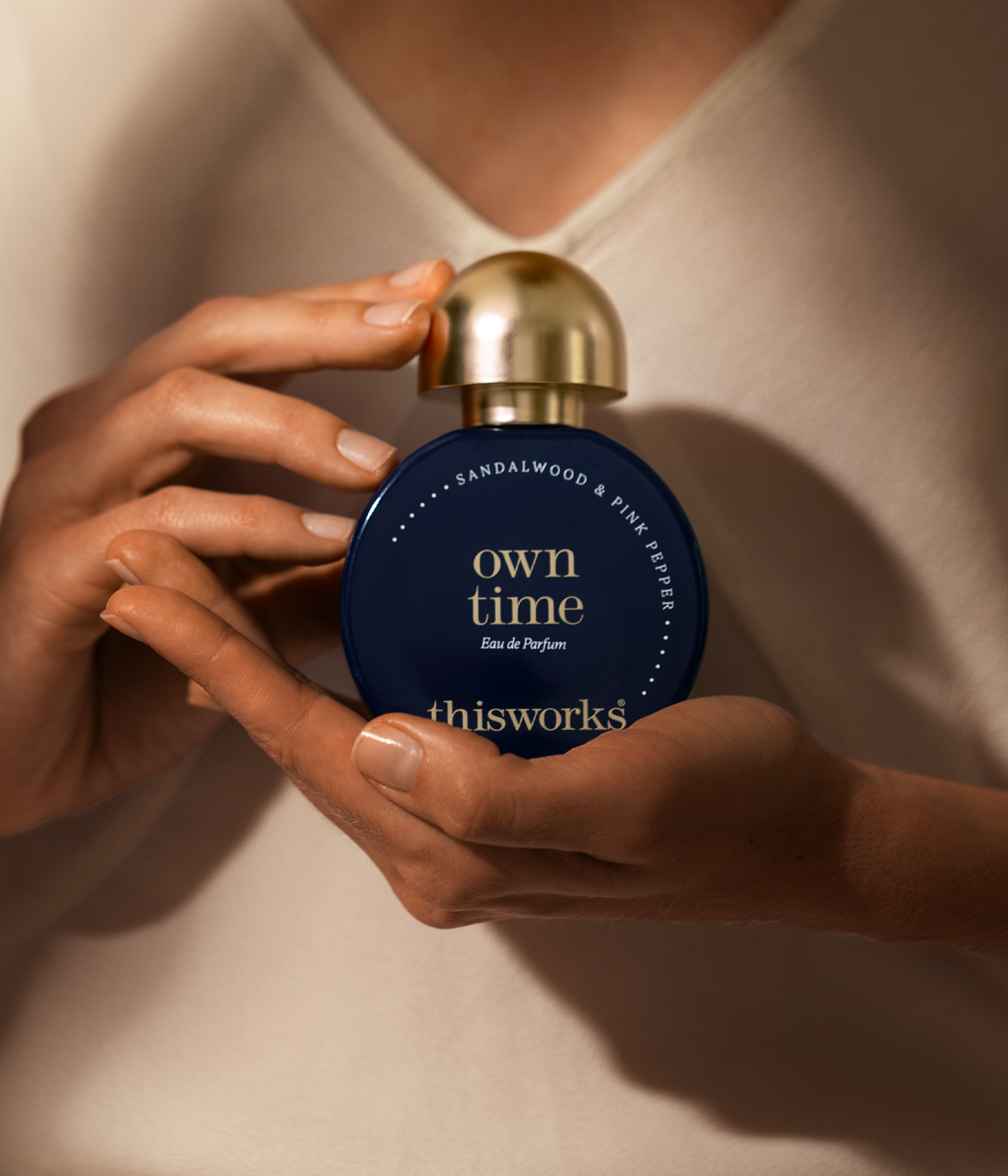
The other one is Own Time.
Anna: You’re going to take a fragrance?
Mithra: I love Own Time.
When I was listening to you talk about why you created Own Time, it just rang bells.
I thought, “She’s made this for me.”
In the evenings, you get home and you’re so busy.
The last thing you’re doing is taking care of yourself, especially if you have children.
It’s really made a difference to my evenings.
I couldn’t be without it.
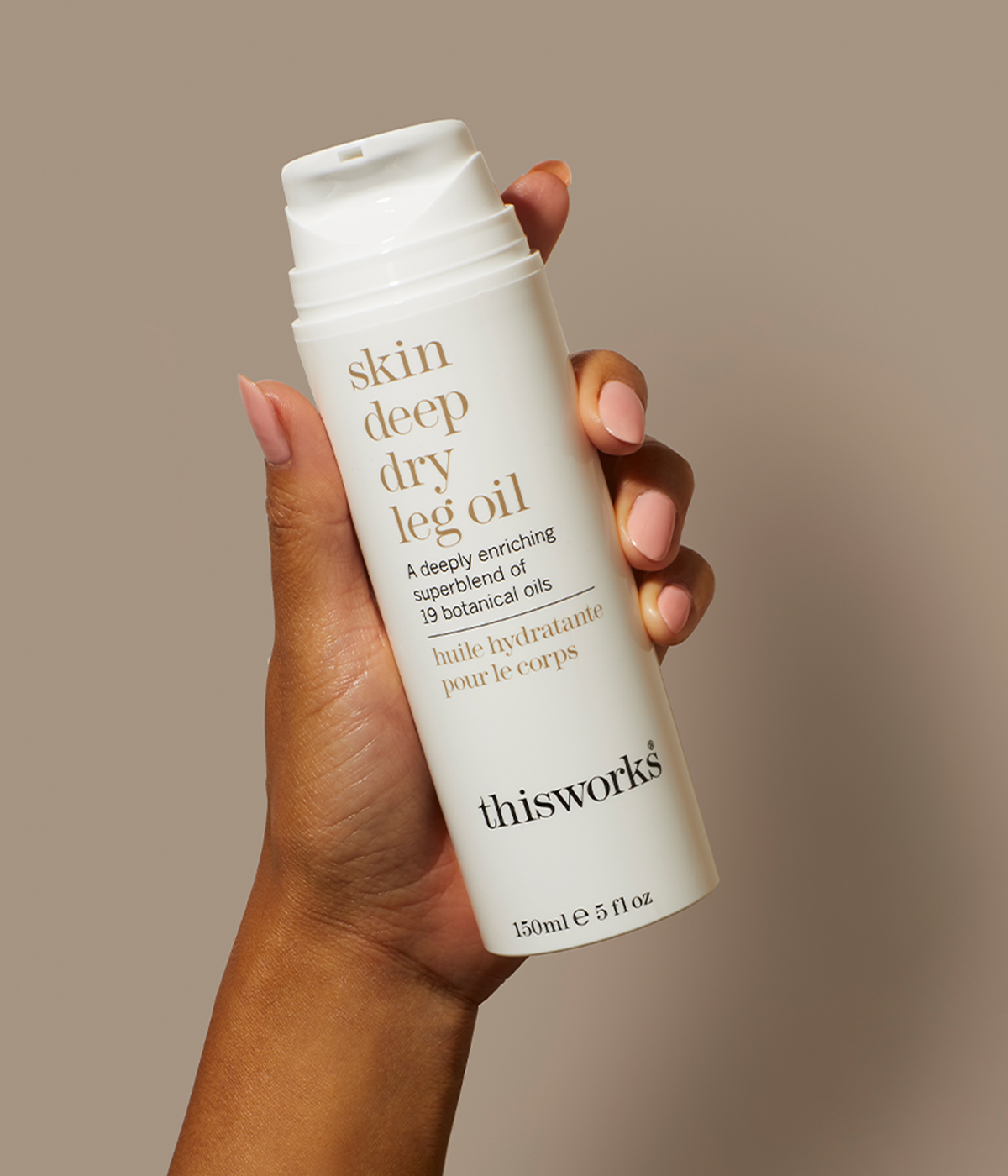
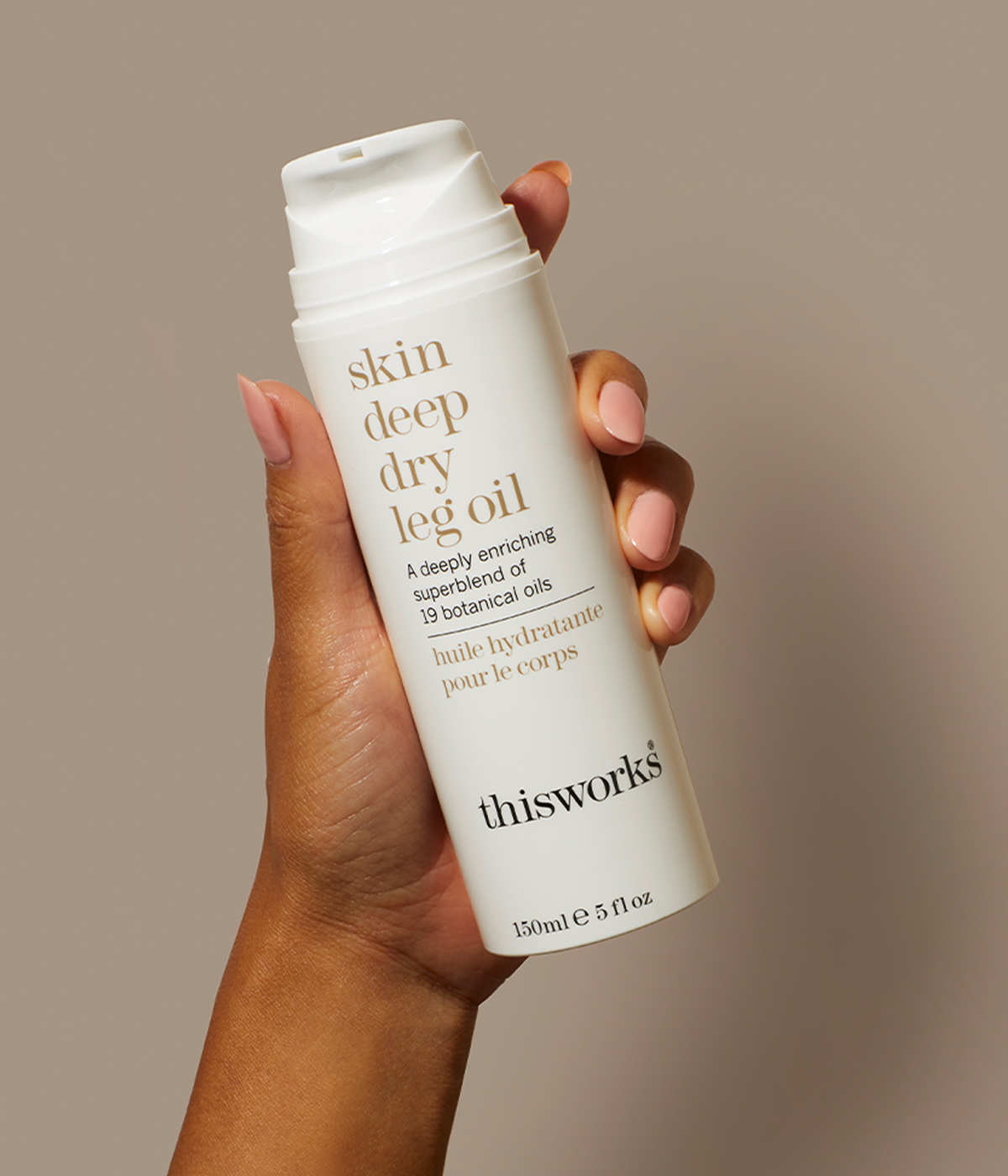
And last but absolutely not least would be skin deep dry leg oil.
That’s an oil I don’t just use on my legs.
I use it all over my body.
I use it after swimming too because chlorine can really dry out the skin.
Anna: So we’ve given you the three products.
You’ve taken perfect cleavage & neck serum, which you can use in other areas.
You’re taking skin deep dry leg oil, which is deeply moisturising and rich in oils and antioxidants.
And you’re taking Own Time as a regulating fragrance to help you balance your nervous system.
Good choices, Mithra.
Mithra: Thank you.
I’m glad you approve.
choosing to go grey
Anna: I’ve been talking with Dr Lana Gault about the upper body and the things that happen there.
What can we do if we’re trying to delay some of the visible signs of ageing and increase our health span and the health span of our skin?
One of the areas we touched on was hair.
We both work in cosmetics and beauty.
You made a decision to go grey.
Tell me about that.
Mithra: I was dyeing my hair regularly and it was getting more and more regular.
It was quite reddish and had a lot of blonde highlights.
It was quite brassy.
Then in a very short space of time my roots would come through.
I’m Middle Eastern, so the roots are really dark.
There were so many different colours going on in my hair.
It was time-consuming and the condition of my hair was really dry as well because I was constantly dyeing it.
I decided to go and see someone who was a grey-blending expert.
It took a few appointments to get my hair colour back closer to its original colour and then let the greys come through.
Now the greys are coming through.
I actually think grey hair can soften your features as you get older.
When I look at older photos of myself with dyed hair, it can look quite harsh.
I look at the greys like natural highlights.
Anna: It looks very beautiful.
I think it’s a great example for other women who have dark hair and want to go grey.
At the same time, the skin on your face and body looks really young.
You said you don’t put your body in the sun.
Mithra: Not anymore.
Anna: And SPF every day?
Mithra: Religiously.
caring for the neck and décolletage
Anna: You’ve been the model for This Works for perfect cleavage & neck serum.
We’ve sold hundreds of thousands of bottles with you as such an excellent ambassador.
This part of your body – how do you take care of it?
Mithra: It’s a very delicate area.
As you get older, it gets thinner.
It’s also an area we don’t always think about.
We’re walking around wearing lower-cut tops.
I never used to think about putting SPF there.
Then suddenly you wake up one morning, maybe you’ve slept on your side, and there’s a line.
You think, “Where has that come from?”
Then I became much more religious about it.
I love using our natural scrub, the Himalayan salt scrub with oils, on this area.
With perfect cleavage & neck serum, I increased from once a day to morning and night.
If I’m out and wearing a V-neck or something lower cut, I use SPF.
I bring the serum all over the bust, right up to the jawline, and also around the back of the neck.
We talk about how the back of the neck also supports the posture of the upper body and it is an area we often completely neglect.
I do all of those things religiously.
It’s interesting because in my travels, I do a lot of training and go to lots of different stores.
I’ve met a few men who use perfect cleavage & neck serum on their neck now because they’re constantly looking down at their phones and have that tech-neck effect going on.
So there are lots of men using it as a neck cream as well.
movement and how you start the day
Anna: You also said at the beginning that you swim regularly.
Thinking about this upper body piece, you are using movement and those muscles too.
Mithra: Yes.
I swim about three times a week.
You know those days when you get out of bed and stub your toe, then miss your train, and suddenly there’s a catalogue of things that go wrong?
Something I’ve learnt at This Works is that how you sleep is important, but how you wake up is also really important.
If I can, I’ll swim before work.
I’m using the muscles and exercising.
Something I’ve also started doing on my days off at the weekend is having a bath in the morning.
Anna: Very luxurious.
Mithra: It’s time spent well.
You wake up and think, “This is a great start to my day.”
Anna: This is part of our body-to-mind philosophy.
We know the body sends messages to the brain as well as the brain sending messages to the body.
If we’re trying to achieve autonomic balance, manage stress and enjoy feelings of positivity, joy and pleasure, we also need to think about what we’re doing with the body.
Having a bath in the morning can help the body relax and help you feel good in your skin.
Then no doubt you have a body-care routine afterwards, including touch.
That makes complete sense as to how it helps you enter the day in a good frame of mind.
I think that’s an excellent recommendation.
Mithra: There isn’t always time to do it.
But if it’s a day off or the weekend and I’m not working, it’s a really great way to start the day.
Obviously I don’t want to call you and say, “Sorry Anna, I’m in the bath.”
Anna: I’m not going to let you run with that excuse!
ageing, confidence and aesthetic medicine
Anna: Mithra, you look amazing.
One of the things I always love is when we go on shoots, we invite you alongside other staff members who are sometimes 20 years your junior.
You’re on set with these younger women.
There’s an intergenerational bond.
You’re a great inspiration to the team.
I think they all look up to you and admire you.
How do you view aesthetic medicine?
What’s your view on it?
Mithra: I think it’s up to personal choice.
I don’t think we should put ourselves under pressure.
There came a point where I said to myself, “Do you know what? I’m 50-something. I don’t want to look 20. I am who I am.”
When I first hit 50, I started doing things like Botox quite religiously and I was quite focused on it.
After a while I thought, “I don’t want to look like a 20-year-old. I am who I am.”
So now if I do it, I usually do it if I feel like I look a bit angry around here, but maybe only once a year.
I think it’s really important to find someone in aesthetics who is prepared to tell you no.
The doctor I was seeing, I asked him to do my lips and he said, “You’d look ridiculous.”
He refused to do them.
So I think it’s good to find someone who will say no to you as well.
Do your research if you’re going to do it.
Anna: Mithra, it’s been a delight to spend time with you because I’ve known you so long.
I love you a lot.
Mithra: I love you too.
Anna: Happy birthday.
Mithra: Thank you.
Anna: Thank you so much for joining us today.
Mithra: My pleasure. Thank you so much for inviting me.
Mithra’s upper body routine
Mithra: We’re not at home today, we’re in the studio, so I haven’t done my step one.
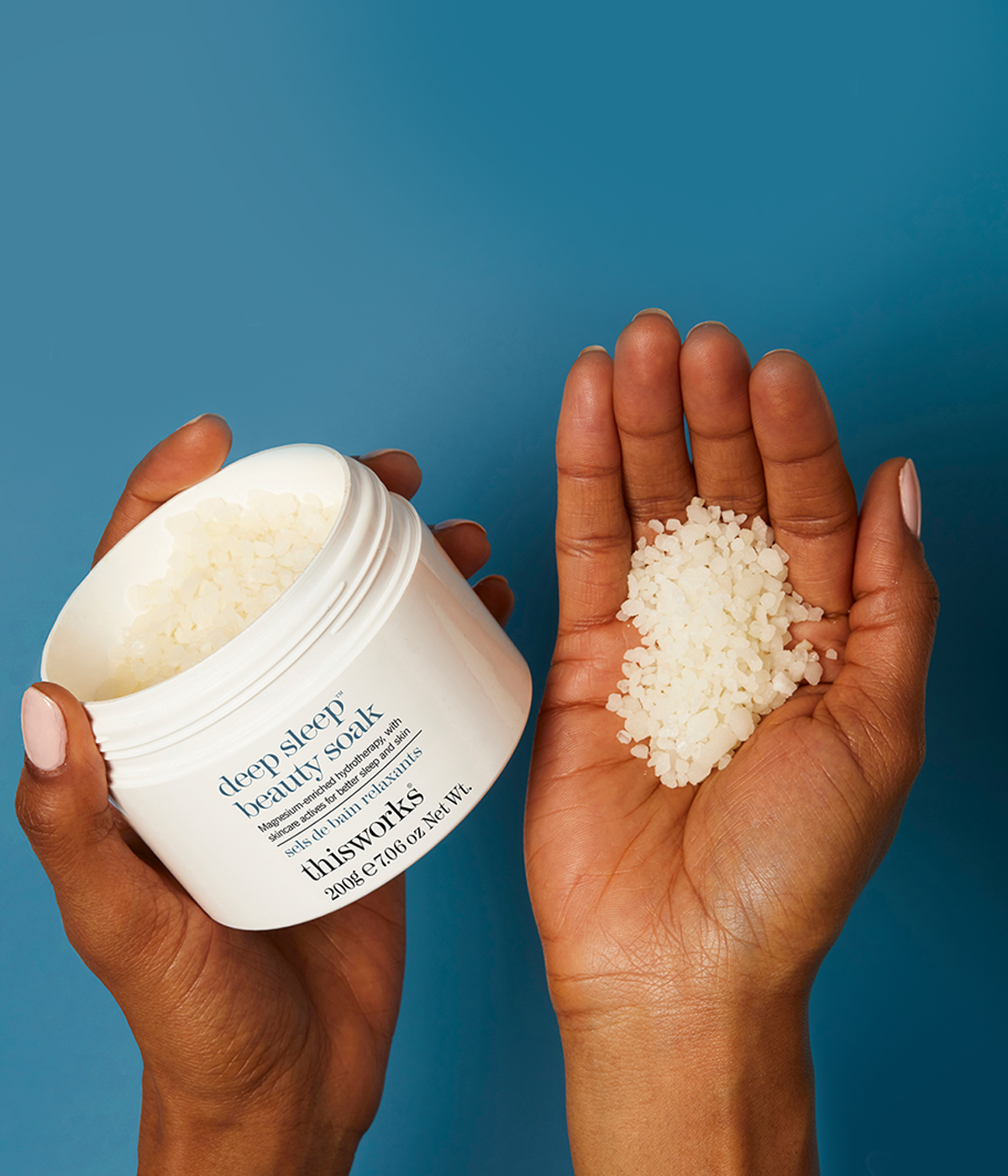
But ordinarily, if I want the chest and neck area to look its best, I would start with our 100% natural scrub.
I use the scrub on dry skin.
Massage it onto the cleavage area and right up to the neck area, then rinse it away.
Dry the skin and follow with perfect cleavage & neck serum.
One of the things I love about this product is how lightweight it is.
As we said, this area is very thin and delicate.
The last thing you want to do is use a heavy cream that is going to pull or drag the skin.
This is really lightweight.
It’s almost like a lotion.
You apply it on the bust area and also on the neck.
When you’re doing the neck, bring it right up to the jawline.
It penetrates into the skin very easily and quickly.
Also, don’t forget the back of the neck.
The back of the neck is really important too.
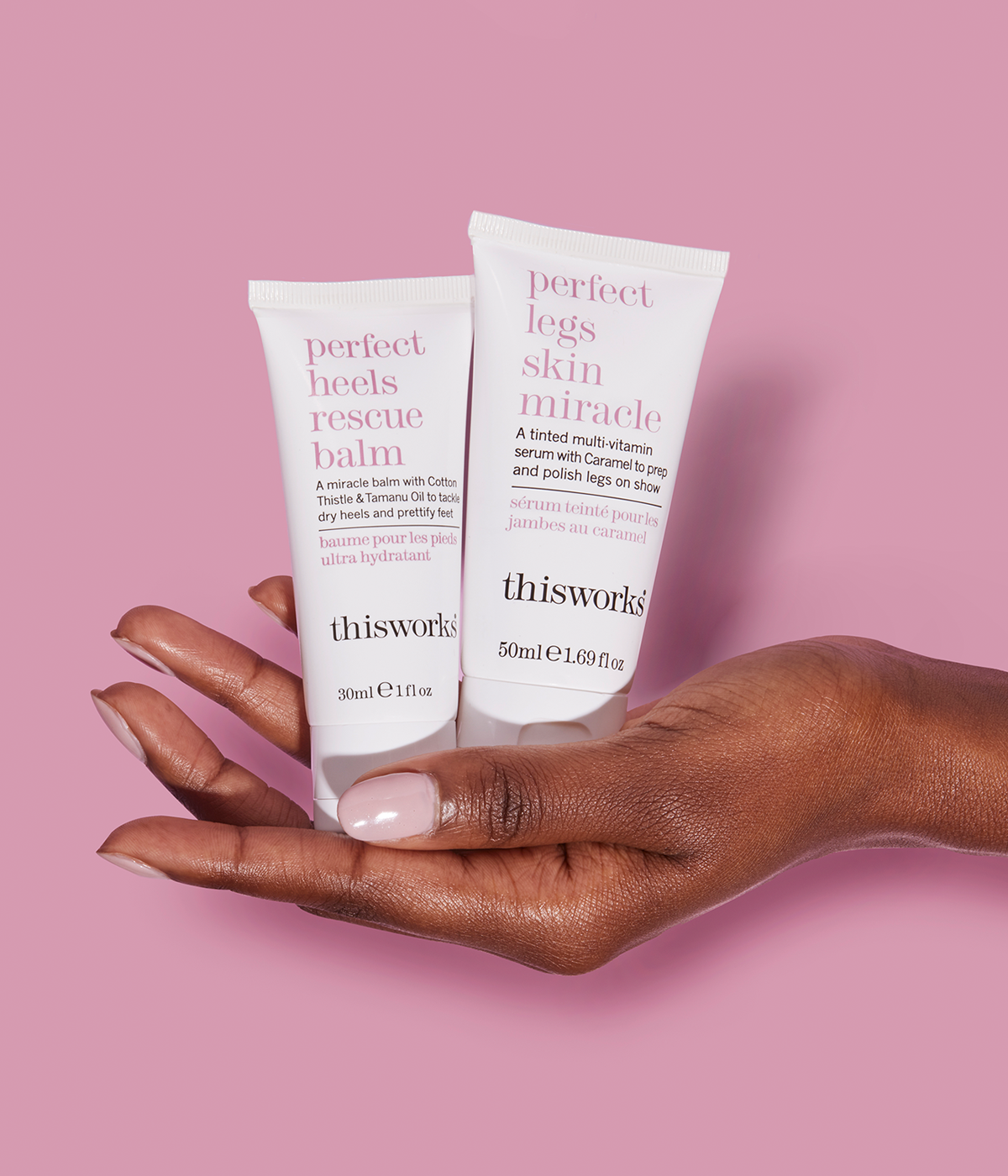
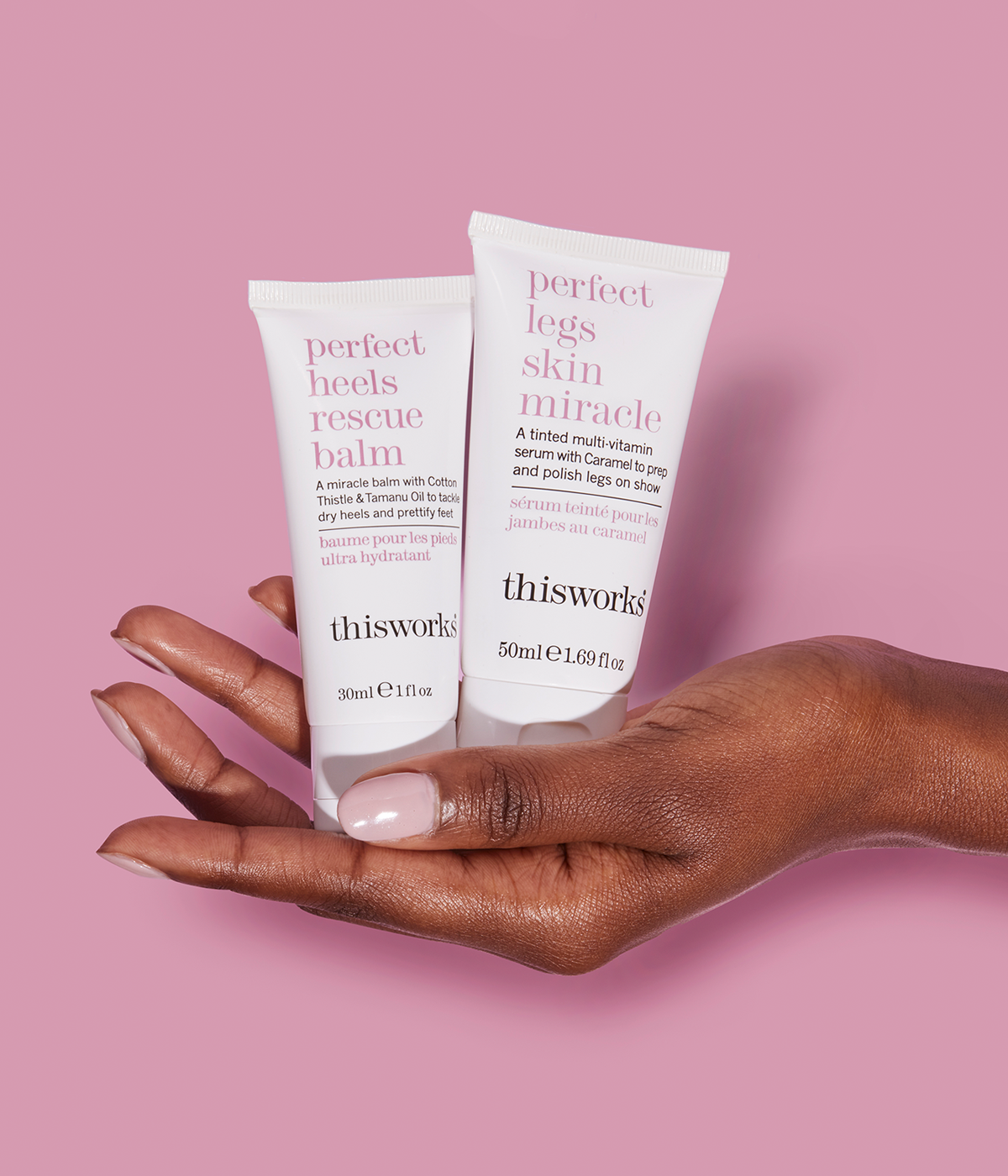
Next, if you want to give your skin an instant glow, perfect legs skin miracle is not just for legs.
This product uses caramel for colour and gives the skin a golden tone.
There’s nothing to stop you applying it elsewhere, for example onto the chest if you’re wearing a V-neck.
It also contains ingredients including vitamin C, vitamin E and arnica.
The best thing about perfect legs skin miracle is that at the end of the day it washes away.
If you’re someone who is concerned about fake tan, the smell or how the colour is going to turn out, you don’t have to worry about that with perfect legs skin miracle.
practical tools for shifting from fight or flight into rest and digest
Anna: Hello, my name is Dr Anna Persaud and I am the CEO of This Works.
Today we want to talk about how we can learn to manage our nervous system to give us more flexibility to move from fight or flight into rest and digest.
As we look at the upper body, how can we make a difference?
Autonomic balance – the balance between fight or flight and rest and digest – is influenced by multiple pathways in the nervous system, including the vagus nerve.
The vagus nerve interacts with the autonomic nervous system and has a significant role in processes including heart rate, digestion and recovery.
We can learn to interact with these systems and, in doing so, give ourselves tools to influence how the nervous system responds to the world around us.
One direct non-invasive area being researched for vagus nerve stimulation is the ear.
There are devices on the market that use a small electrical current around parts of the ear to stimulate branches of the vagus nerve.
The intention is to support vagal activity and improve our ability to move from fight or flight towards rest and digest.
Another technique that all of us can use, very much focused on the upper body, is affective touch.
There are sensory nerve fibres in the skin associated with slow, gentle touch.
This type of touch can send signals associated with safety and social connection towards the brain.
The technique is done slowly.
Using intentional touch across the upper part of the body – the shoulders, arms and décolletage – with or without products can become another tool for relaxation and nervous system regulation.
Affective touch is also associated with social bonding processes including oxytocin.
Oxytocin has been studied for its role in social connection and its interaction with stress responses.
Using slow, reassuring touch can therefore form part of a wider set of tools for helping ourselves move towards relaxation.
Using cold water on the face can also be an effective way of influencing the stress response.
Humans have something known as the mammalian dive reflex.
Cold water on the face can trigger physiological changes including a slowing of the heart rate.
That can become another tool for shifting out of a highly activated state.
Humming and singing are enjoyable ways to support nervous system regulation too.
When you sing or hum, you naturally tend to extend the exhale.
A longer exhale can support parasympathetic activity.
There is also vibration through the throat, skull and neck.
Humming has also been associated with increased nasal nitric oxide production.
Then there is the social benefit of singing together with other people if that’s something you choose to do.
A lot of our tension is held in the upper body, jaw and neck.
Learning how to release tension in these areas can send a different set of signals back towards the brain.
It comes back to mindful awareness – interoception – and noticing what is happening in the body.
You might deliberately clench an area and then release it.
You might soften the jaw.
You might lower the shoulders.
You might take a slow breath out.
These are small things that we can do frequently throughout the day to give the nervous system a greater sense of balance.
related posts
 expertsgetting on your nerves? episode 5: the September switchIn episode 5 of getting on your nerves?, Dr Anna Persaud is joined by medical doctor Dr Lana Gault to explore the September switch – how the transition from summer into autumn affects our physical health, mental wellbeing, sleep and...read post
 expertsgetting on your nerves? bonus episode: getting out of your head, into your bodyIn this Wellness Weekender special of getting on your nerves?, Dr Anna Persaud is joined by wellness expert and integrative therapist Esther Triviño to explore somatic yoga, interoception, nervous system regulation and how movement, breath, sound and sensory cues can...read post
 expertsgetting on your nerves? episode 4: wherever I lay my hatWhy can some people sleep anywhere, while others struggle as soon as their surroundings change? Dr Anna Persaud and Professor Gaby Badre explore sleep adaptability, circadian rhythm, nervous system regulation and how to become a more resilient sleeper when conditions...read post
 expertsgetting on your nerves? episode 2: the upper body editIn episode 2 of getting on your nerves?, Dr Anna Persaud is joined by Dr Lana Gault and This Works ambassador Mithra Nandu to explore how stress and nervous system dysregulation show up in the upper body. From jaw tension,...read post
 expertsgetting on your nerves? episode 1: signs you are stressedIn episode 1 of getting on your nerves?, Dr Anna Persaud is joined by medical doctor Dr Lana Gault to explore how stress first shows up in the body and mind. From burnout, fatigue and disrupted sleep to fight or...read post
 expertsgetting on your nerves? episode 3: the power of nowIn episode 3 of getting on your nerves?, Dr Anna Persaud is joined by psychotherapist and trauma expert Lauren Baird to explore why being present can feel so difficult. From negativity bias, fight or flight and the window of tolerance...read post
 sleep hygienecan you train your brain for bedtime?Can a familiar scent become a signal that it is time to sleep? Professor Gaby Badre explores the connection between scent, the brain and nervous system — and how repeated sensory cues may help support the transition from daytime alertness...read post
 sleep hygienewhen the brain won’t switch off: understanding chronic insomniaWhy can sleep remain difficult long after the original trigger has passed? Professor Gaby Badre explores the science of chronic insomnia, the hyperarousal that can keep the brain alert at night, and how the brain can be retrained for sleep.read post
